The Counter Where Strangers Talked: What Happened to the American Diner
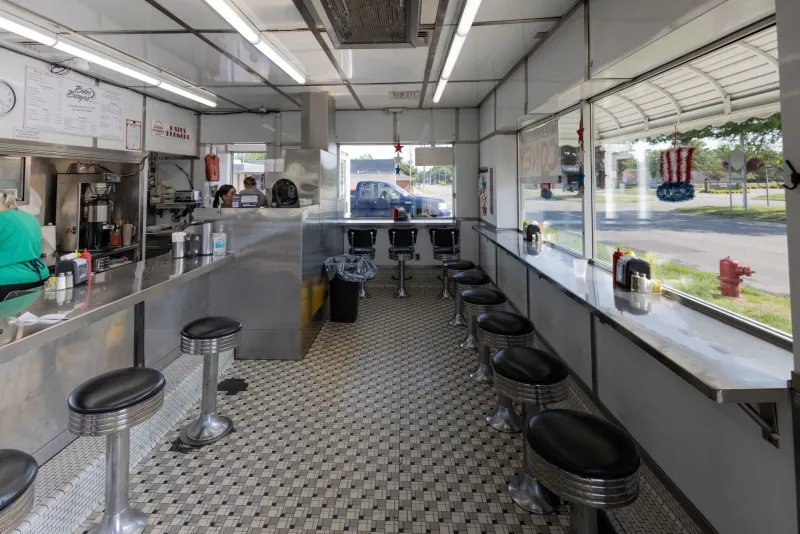
Picture a Tuesday morning in 1962. A man in a work shirt slides onto a stool at the counter of a diner somewhere in Ohio. He orders coffee and eggs. The woman two stools down is a school secretary. The guy at the end is a plumber who comes in every morning. The waitress knows all three of them by name, knows how they take their coffee, knows roughly what's going on in their lives.
By the time breakfast is over, they've talked about the weather, argued mildly about the new highway being built outside of town, and the school secretary has mentioned that her cousin is looking for plumbing work. A small, informal economy of information and connection has taken place over forty-five minutes and two refills.
Now picture a Tuesday morning in 2024. Someone orders a breakfast burrito through an app, watches it arrive in a paper bag, eats it alone at their desk while scrolling through their phone, and throws the packaging away before their first meeting.
The food is probably fine. The rest of it is gone entirely.
The Diner as Social Infrastructure
The American diner reached its peak somewhere between the 1940s and 1970s. These weren't just restaurants. They were neighborhood institutions — the kind of place where the physical design actively encouraged conversation. Counter seating meant you were sitting next to strangers by default. Booths were close enough together that neighboring conversations occasionally merged. The open kitchen meant you could talk to the cook. The whole setup was built, whether intentionally or not, for human contact.
Supper clubs in the Midwest and South operated on a similar principle but with more ceremony. Families dressed up. Meals lasted two or three hours. There was a house band on weekends. You didn't go to a supper club to fuel up — you went to be somewhere, with people, for the evening.
The social function of these spaces was inseparable from their economic function. They weren't just selling food. They were selling belonging.
The Efficiency Revolution
Something began shifting in the 1970s and accelerated sharply through the 1980s and 1990s. Fast food had been around since the 1950s, but it moved from the margins to the mainstream during this period. McDonald's, Burger King, and Wendy's didn't just offer cheaper food — they offered a fundamentally different relationship with eating out. Faster. More predictable. Designed for throughput rather than lingering.
The physical design of these spaces was engineered, quite deliberately, to keep people moving. Hard seats. Bright lights. No comfortable corners to settle into. The message embedded in the architecture was: eat and go.
As chains expanded and diners contracted, something subtle but significant happened to the American understanding of what a restaurant was for. Eating out shifted from a social event to a logistical solution.
What Fast-Casual Finished
The rise of fast-casual dining in the 2000s — Chipotle, Panera, Shake Shack — added a veneer of quality to the efficiency model without restoring the social dimension. These restaurants offered better ingredients and a more pleasant environment, but the fundamental design philosophy remained: move people through, maximize table turns, optimize for speed.
The arrival of delivery apps completed the transformation. DoorDash launched in 2013. Uber Eats followed in 2014. By 2020, accelerated dramatically by the pandemic, food delivery had become a primary mode of dining for millions of Americans. According to industry research, the U.S. food delivery market grew from around $8 billion in 2016 to over $26 billion by 2022.
The restaurant, in this model, becomes a production facility. The diner becomes a customer. The transaction is complete. Nothing social has occurred.
The Economics of Isolation
There's a financial angle to this story that doesn't get enough attention. The old diner model was, in many ways, extraordinarily cost-effective as a social institution. For the price of a cup of coffee and a plate of eggs, you got hours of community connection, local information exchange, and the low-grade but genuine pleasure of being known somewhere.
Modern dining, particularly delivery, costs significantly more per meal while delivering significantly less in social terms. The average delivery order in the U.S. runs $30 to $40 after fees, tips, and the inevitable service charges layered on by platforms that take a substantial cut from both the restaurant and the customer. You're paying a premium to eat alone.
And restaurants themselves are suffering. The commission structures imposed by major delivery platforms — often 15 to 30 percent per order — have squeezed margins at exactly the independent establishments most likely to carry on the diner tradition. The places most likely to know your name are the ones least able to survive the current economics of the industry.
The Table That Stayed Empty
Not everything about the old model was idyllic. Diners in mid-century America were often segregated, unwelcoming to people outside a particular demographic, and slow to change. The nostalgia for that era needs to hold those realities alongside the warmth.
But the underlying social function — the idea that a shared meal in a public space could be a genuine act of community — was real and valuable. Research consistently shows that eating with other people, even with strangers, improves mood, builds social trust, and contributes to a sense of belonging that is genuinely good for mental and physical health.
We've traded that for convenience, and the trade has been more expensive than the delivery fee suggests.
Something Worth Preserving
The classic American diner hasn't entirely disappeared. There are still places where the coffee is bad and the pie is excellent and the person next to you at the counter will tell you something interesting before you finish your second cup. They tend to be beloved by their communities in a way that no chain restaurant achieves.
That affection is telling. It's not nostalgia for inferior food. It's recognition of something the efficiency model quietly eliminated: the understanding that eating out was never really just about the eating.