The Forecast Used to Be a Guess. Now It's a Miracle. Here's What Changed.
The Forecast Used to Be a Guess. Now It's a Miracle. Here's What Changed.
There's a scene that played out in kitchens across America every morning for most of the 20th century. Someone glances at the sky, flips on the TV, half-listens to a cheerful person standing in front of a magnetic cloud cutout, and then grabs an umbrella anyway — just in case. Because you never really knew.
That instinct made perfect sense. Because for most of human history, the weather forecast was, at best, an informed opinion. At worst, it was barely better than a coin flip.
The story of how that changed is one of the most quietly astonishing scientific journeys of the last hundred years — and most of us have been living through it without pausing to notice.
When the Sky Was a Mystery
Before the 1950s, weather prediction was a patchwork operation. Meteorologists gathered surface observations from weather stations scattered across the country, plotted them by hand onto maps, and tried to extrapolate where storm systems were heading. The data was sparse, the tools were limited, and the atmosphere above 10,000 feet was largely invisible.
A forecast for tomorrow was educated guesswork. A forecast for three days out was borderline reckless. The National Weather Service issued outlooks, but forecasters themselves understood the limitations. They were working with a partial picture of an enormously complex system.
Farmers relied on almanacs and personal observation. Ship captains watched barometers with a kind of religious attention. Everyone else just kept one eye on the clouds.
And then the space age arrived and changed everything.
The Satellite Revolution
In April 1960, the United States launched TIROS-1 — the world's first successful weather satellite. Its cameras were crude by modern standards, its orbit unstable, and its operational life just 78 days. But for the first time in history, humans could look down at the atmosphere from above.
The images were grainy and partial, but they showed something meteorologists had never seen: the actual shape and movement of storm systems from space. Hurricane hunters no longer had to fly directly into storms to find them. Forecasters could track weather patterns across entire ocean basins. The blind spots that had made long-range prediction nearly impossible began to shrink.
By the 1970s, geostationary satellites were providing continuous coverage of the continental United States. The picture was getting clearer — literally and scientifically.
Doppler Changes the Game
Satellites told forecasters where storms were. Doppler radar told them what was happening inside them.
The National Weather Service began deploying its NEXRAD Doppler radar network across the country in the late 1980s and early 1990s. The difference was transformative. Where older radar systems could detect precipitation, Doppler could measure the velocity of rain and wind within a storm. Forecasters could now see rotation inside a thunderstorm — the signature of a developing tornado — before a funnel cloud ever touched the ground.
The average warning time for a tornado before Doppler radar was roughly five minutes. After widespread Doppler deployment, that lead time stretched to 13 minutes or more. That might not sound dramatic until you consider what 8 extra minutes means when a tornado is heading toward your neighborhood.
Deaths from tornadoes dropped significantly over the following decades. Not entirely because of radar, but radar was central to it.
Supercomputing and the Numerical Revolution
Satellites and radar gave forecasters better eyes. Supercomputers gave them something even more powerful: the ability to model the atmosphere mathematically.
Numerical weather prediction — using physics equations to simulate atmospheric behavior — had been theorized since the early 20th century. But the calculations required to run even a basic atmospheric model were so immense that they exceeded human capacity. It took the advent of modern computing to make it practical.
Today's forecast models process data from thousands of weather stations, hundreds of weather balloons, dozens of satellites, commercial aircraft, ocean buoys, and even GPS signals that measure atmospheric moisture. That data feeds into models running on some of the most powerful computers on Earth, generating probabilistic forecasts that update continuously.
The result? A modern five-day forecast is now roughly as accurate as a one-day forecast was in 1980. A modern three-day forecast beats the accuracy of a 36-hour forecast from the early 1990s. That's not a marginal improvement. That's a generational leap.
What Accuracy Actually Means
Better forecasting has consequences that ripple far beyond whether you need an umbrella.
American farmers now make planting and harvesting decisions based on 10-day outlooks with genuine confidence. Airlines route flights around weather systems hours before departure, saving fuel and reducing delays. Emergency managers in hurricane-prone states have days — not hours — to order evacuations before major storms make landfall. The economic value of improved weather forecasting has been estimated in the tens of billions of dollars annually.
The 1900 Galveston hurricane killed an estimated 8,000 people with virtually no warning. When Hurricane Harvey made landfall in 2017 as a catastrophic storm, forecasters had predicted its general track and intensity days in advance. The warning systems weren't perfect, and the flooding was devastating — but the death toll, while tragic, was a fraction of what an equivalent storm would have caused a century earlier.
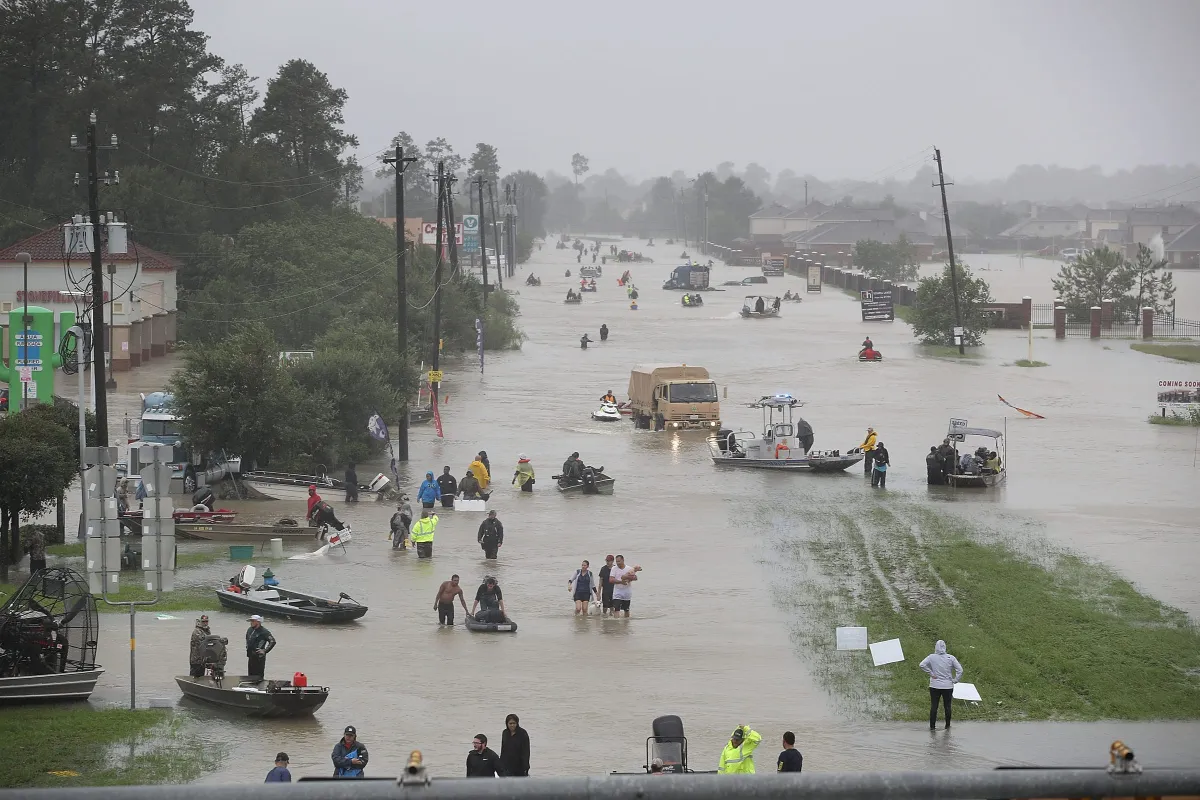 Photo: Hurricane Harvey, via static1.businessinsider.com
The Forecast You Take for Granted
Next time your phone buzzes with a severe weather alert, or you casually check the weekend forecast to plan a barbecue, take a second to appreciate what's actually behind that prediction. Satellites orbiting 22,000 miles above Earth. Radar networks scanning millions of cubic miles of atmosphere. Supercomputers running billions of calculations per second. Decades of scientific progress built on top of decades more.
Your grandparents watched a man with a magnetic cloud and hoped for the best. You're carrying the most accurate weather prediction system in human history in your pocket.
That's a change worth noticing.