Twenty-Four Exposures and a Prayer: How Photography Stopped Being an Event
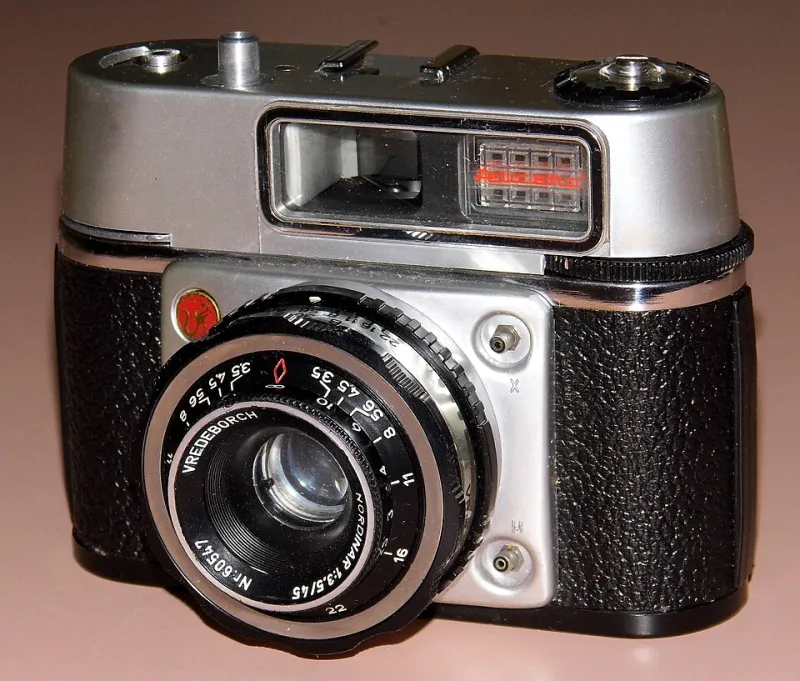
Photo: Joe Haupt from USA, CC BY-SA 2.0, via Wikimedia Commons
There's a photograph of my grandmother at Niagara Falls, taken sometime in the late 1950s. She's squinting slightly into the sun, wearing a cotton dress, with the mist rising behind her. It's a little blurry. The horizon tilts maybe three degrees to the left. And it is, without question, one of the most carefully preserved objects in our family.
Somewhere on my phone right now, there are roughly 4,000 photos I have never looked at twice.
This is not a complaint about technology. The things a modern smartphone camera can do — in low light, at distance, in motion — would have seemed like science fiction to a professional photographer in 1975. But the shift from film to digital didn't just change the equipment. It changed the entire meaning of taking a picture. And the gap between those two worlds is wider than most of us have stopped to consider.
The Weight of a Finite Roll
If you grew up before digital cameras became mainstream — roughly, before the early 2000s — you remember the particular weight of a limited roll of film. You got 24 exposures. Sometimes 36. That was it. Every frame had a cost, not just in money but in the irreversible commitment of using one of your precious shots.
This scarcity shaped behavior in ways that were almost meditative. You thought before you shot. You waited for the right moment, positioned yourself deliberately, checked the light. You made a decision, then you pressed the shutter, and then you moved on — because you couldn't afford to spray and pray.
Vacations were especially charged. Families heading to Disney World or the Grand Canyon or a national park would often bring two or three rolls of film, carefully rationed across the trip. Dad was in charge of the camera. There were discussions about which moments deserved a shot. The graduation, the first glimpse of the ocean, the birthday cake — these were allocated exposures. A random sunset, however beautiful, might not make the cut.
And then you waited. You dropped the roll at the drugstore or the one-hour photo kiosk at the mall, and you came back days later — or a week later, if you'd been frugal and saved up multiple rolls — and you opened that little envelope with genuine anticipation. What did we get? Did it come out?
Sometimes it didn't. The flash failed. Someone blinked. The composition was off in a way you hadn't noticed in the moment. That photograph of the kids on the beach? Ruined by a thumb over the lens. Gone forever, unrepeatable, just a memory without documentation.
The Darkroom as Sacred Space
For serious amateur photographers — and there were a lot of them, gathered in camera clubs and community college courses across America — the darkroom was something close to a ritual space. Developing your own film and printing your own photographs was a skill that took real time to learn and real patience to execute.
You worked in near-darkness, by the amber glow of a safelight. You watched images materialize in developer solution, appearing slowly on blank white paper like something emerging from a dream. The process was chemical and physical and deeply tactile in a way that clicking a smartphone is not.
That process also created a different relationship with the resulting image. You had invested hours in it. You had made choices — about contrast, about exposure time, about cropping — that required genuine knowledge. The photograph you held at the end was something you had made, not just captured.
The home darkroom was a real feature of American suburban life from the 1950s through the 1980s. Kodak, which dominated the amateur photography market for most of the 20th century, built an entire ecosystem around it: cameras, film, developing chemicals, printing paper, and the aspirational promise that ordinary families could preserve their memories with craft and care.
When Digital Changed the Calculus
The first consumer digital cameras arrived in the 1990s, and they were expensive, clunky, and produced images that looked like they'd been photographed through a screen door. But the core proposition was revolutionary: you could see your photo immediately, and if you didn't like it, you could delete it and try again.
The deletion button changed everything.
Once photographs became free to take and free to discard, the entire psychology of picture-taking inverted. Instead of conserving shots, you maximized them. Instead of waiting for the perfect moment, you captured every moment and sorted later. Instead of one careful composition, you took fifteen versions and chose the best one.
This is, in many ways, a genuine improvement. You get better photos. You miss fewer moments. You can shoot in conditions that would have been impossible on film. Nobody mourns the lost rolls of underexposed vacation shots.
But something else shifted alongside the technology — something about the relationship between the photographer and the moment being photographed.
The Paradox of Infinite Memory
Researchers have studied what psychologists call the "photo-taking impairment effect" — the finding that people who photograph an experience remember it less clearly than those who simply live it. When you point a camera at something, part of your brain outsources the memory to the device. Why hold onto it yourself when the phone will?
This effect was probably present with film cameras too, but at a much smaller scale. You took a handful of photos and experienced the rest. Now, for many people — especially at concerts, graduations, or tourist landmarks — the entire event is mediated through a screen.
The infinite scroll of the digital photo library has also changed how we curate memory. The physical photo album was an editorial act. You chose which images to print, which to mount, which story to tell about your life. Those albums were narratives. The 40,000-image camera roll is not a narrative. It's an archive that nobody will ever fully explore, including you.
What the Drugstore Envelope Understood
There's a reason people still buy instant cameras — Polaroids and their modern equivalents — even though the image quality is objectively worse than any smartphone. It's not nostalgia, exactly. It's something more specific: the desire for a photograph that is an object, that lives in the physical world, that can be held and pinned to a wall and found in a drawer twenty years from now.
Your grandmother's slightly blurry photo at Niagara Falls survived because someone thought it was worth keeping. Someone chose it. Someone put it in an album or a frame or an envelope marked do not throw away.
In a world of infinite images, the act of choosing — of saying this one matters — has become the rarest thing of all.