Your Lender Used to Live on Your Street: The Radical Transformation of the American Mortgage

Photo by Photo by Boston Public Library on Unsplash on Unsplash
Somewhere in the mid-1950s, a young couple in Dayton, Ohio — let's call them Robert and Helen — walked into their local savings and loan association to ask about buying a house. The man behind the desk had known Robert's father. He knew the neighborhood they were looking at. He asked about Robert's job at the machine shop, Helen's part-time work at the school, and their plans for a family. Then he made a decision based on everything he knew about them as people, not just as data points.
They got the loan. They bought the house. And for the next thirty years, that savings and loan held their mortgage, collecting payments and staying invested in the neighborhood it had helped build.
That relationship — personal, local, mutually accountable — defined American homebuying for decades. Its disappearance is one of the most consequential and least discussed financial shifts of the past half century.
The Savings and Loan Era: Banking as Community Infrastructure
Savings and loan associations — sometimes called thrifts or building societies — were purpose-built for exactly this kind of transaction. They collected deposits from local savers, paid modest interest, and lent that money to local homebuyers at rates that reflected community stability rather than global capital markets. The business model was almost deliberately boring: borrow short, lend long, keep the spread, stay local.
What made this system remarkable wasn't its sophistication. It was its simplicity and its accountability. The lender and the borrower lived in the same ecosystem. If the neighborhood declined, the savings and loan suffered alongside everyone else. If local employment held steady, loans got repaid and everyone benefited. The interests of lender and borrower were genuinely aligned in a way that's almost hard to imagine today.
Interest rates during this era were regulated under Depression-era rules — Regulation Q capped what savings institutions could pay depositors, which in turn limited what they needed to charge borrowers. Rates were predictable. Terms were standardized. A thirty-year fixed mortgage at a rate your local thrift could sustain was the norm, not the exception.
None of this was perfect. Lending discrimination was real and devastating — redlining systematically excluded Black families and other minorities from the homeownership pipeline for decades. The system's community-mindedness often meant community-exclusiveness. That's an essential part of the history that can't be skipped.
But for the families it did serve, the system worked with a human directness that the current one simply doesn't replicate.
The Securitization Revolution That Changed Everything
The transformation began in the early 1970s, when the federal government — through agencies like Fannie Mae and Freddie Mac — began buying mortgages from local lenders, bundling them together, and selling shares of those bundles to investors. The idea was to increase the flow of capital into housing by connecting local mortgage markets to national and eventually global pools of money.
 Photo: Fannie Mae, via wrenews.com
In many ways, it worked. More capital meant more mortgages. More mortgages meant more homeowners. The 1970s and 1980s saw homeownership rates climb, and the interest rate environment became more responsive to national economic conditions rather than local savings pools.
But securitization fundamentally changed the incentive structure of lending. When a savings and loan held your mortgage on its own books for thirty years, it had every reason to make sure you could actually repay it. When a mortgage originator could sell your loan to a bundler within weeks, who sold shares to investors who had no idea where Dayton, Ohio was, that direct accountability evaporated.
The person who approved your loan no longer cared whether you made your payments. They got paid at closing. What happened afterward was someone else's problem — specifically, the problem of investors who were often relying on credit rating agencies that didn't fully understand what they were rating.
The 2008 financial crisis was, in large part, the catastrophic endpoint of that logic playing out at scale.
The Automated Underwriting Machine
Today, the mortgage process is faster, more standardized, and in some ways more accessible than it was in Robert and Helen's era. Online applications, digital document submission, and algorithmic underwriting mean that a mortgage decision that once took weeks of relationship-building can now be reached in days based on credit scores, debt-to-income ratios, and automated verification systems.
But something real was traded away in that efficiency bargain.
The algorithm doesn't know that you've worked at the same company for twelve years and your manager would vouch for you personally. It doesn't know that the medical debt dragging down your credit score was a one-time event that's been resolved. It doesn't know the neighborhood, the house, or you. It knows numbers, and numbers tell an incomplete story.
For borrowers who fit neatly into standard parameters, the system works reasonably well. For those on the edges — self-employed workers, people rebuilding after a financial setback, first-generation homebuyers without generational credit history — the algorithmic gatekeeping can be as exclusionary as the old system, just in different and less visible ways.
And when you close on a home today, there's a reasonable chance your mortgage will be sold to a servicer you've never heard of within sixty days. The institution that approved you may have nothing to do with collecting your payments. You might make thirty years of payments to three or four different servicers, none of whom you chose and none of whom chose you.
What the Neighborhood Lost
Beyond the individual transaction, something larger shifted when mortgage lending went national. Local savings institutions had a stake in local prosperity that went beyond profit. A savings and loan that held mortgages on Main Street had reasons to care about Main Street's vitality — its employers, its schools, its infrastructure. That connection between local capital and local community wasn't incidental. It was structural.
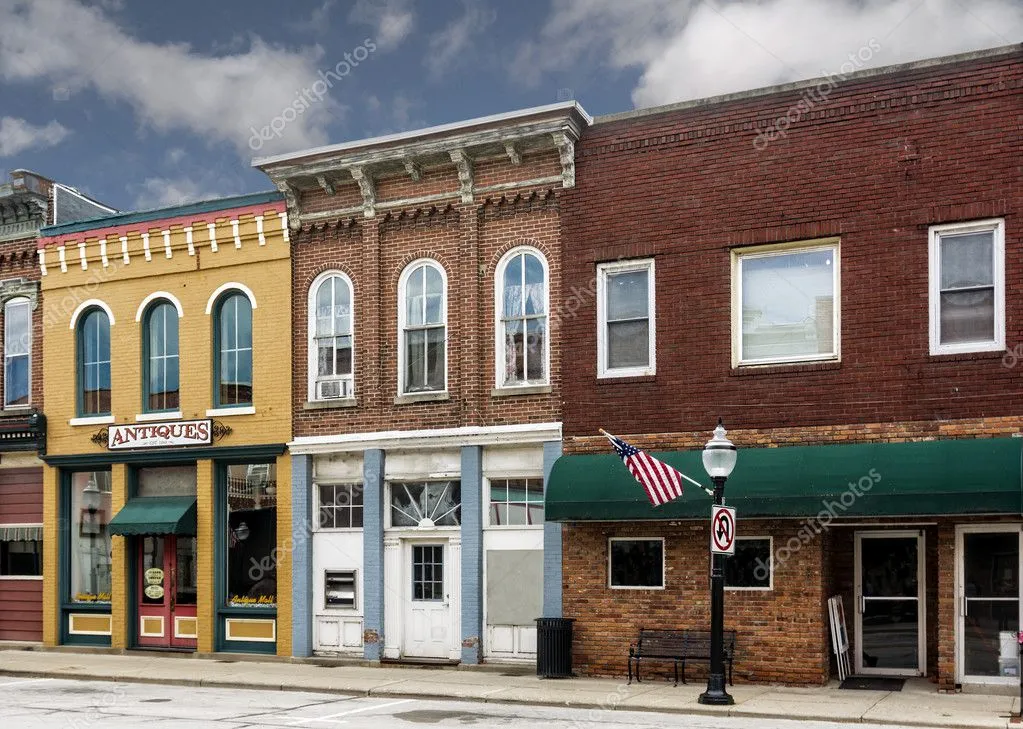 Photo: Main Street, via st.depositphotos.com
When mortgages became global financial instruments, that structural connection dissolved. Capital flows to wherever returns are optimized, not wherever communities need investment. That's not a moral failing — it's just how markets work when they're operating at scale without local accountability built in.
Robert and Helen's lender attended their church. He had reasons, beyond legal obligation, to treat them fairly and to want their neighborhood to thrive. That's not a system anyone would design from scratch today. But it's worth understanding what disappeared when it was replaced — and asking honestly whether the replacement serves everyone as well as we sometimes assume.