When Your Word Was Worth More Than Your Signature: The Death of the Handshake Deal
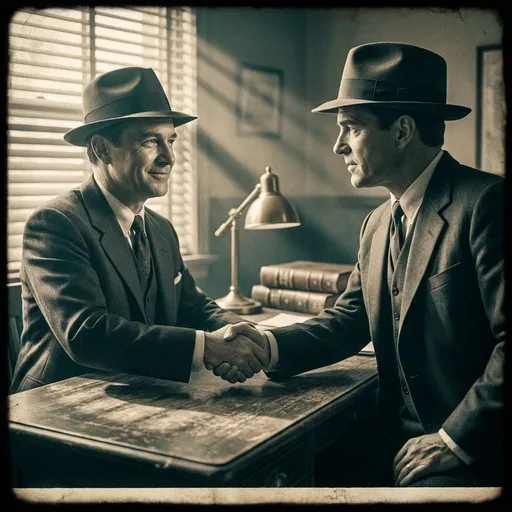
Photo: two businessmen handshake vintage 1950s black and white office, via images.stockcake.com
Picture a grain elevator in rural Kansas, sometime in the early 1960s. Two farmers — maybe neighbors, maybe rivals in the gentle way that neighbors sometimes are — are working out the price for a load of wheat. One of them names a number. The other thinks for a moment. They shake hands. That's it. The deal is done, and both men will honor it completely, because in a small town, your reputation is the only currency that never inflates.
Now picture the same transaction today. There's a purchase agreement, a liability waiver, a dispute resolution clause, and probably a digital signature platform sending automated reminders to both parties. The lawyers are involved before the wheat leaves the field.
Something changed. It wasn't just the paperwork. It was the underlying architecture of trust in American life — and understanding what shifted tells you a lot about how we got here.
The Economy That Ran on Reputation
For most of American history, commerce was local and personal. The merchant who sold you bad flour would lose your business and your neighbor's business and your cousin's business. The contractor who skipped town without finishing the job would never work in the county again. The social consequences of dishonesty were swift, visible, and lasting.
In that environment, a handshake deal wasn't naive — it was rational. Formal contracts were expensive and slow, courts were distant, and lawyers charged fees that most ordinary people couldn't absorb. But none of that mattered much, because the informal enforcement mechanism of community reputation was extraordinarily effective.
This wasn't limited to small-town America. Well into the 20th century, major industries operated on gentleman's agreements and oral understandings that would make a modern corporate attorney's hair stand on end. The New York diamond district — still one of the most trust-based trading environments in the world — was built on handshakes between merchants who would rather lose money than lose their standing in the community. Millions of dollars in gems changed hands on a nod and a Yiddish phrase: mazel und brucha. Luck and blessing. Deal done.
When the World Got Too Big to Know
The first great disruption to reputation-based commerce was scale. As America urbanized through the early 20th century, and as businesses began operating across state lines and eventually nationally, the social fabric that made handshake deals enforceable started to fray.
If you're selling to someone three counties over, they don't know your father. They can't ask around about you at church. The natural enforcement mechanism of local reputation simply doesn't reach that far. And as transactions became more complex — involving more money, more parties, longer timelines — the stakes of a misunderstanding grew too high to leave to goodwill.
Contracts, in this sense, weren't a sign of distrust. They were a translation tool. A way of encoding the understanding that two people had reached, in language that could survive the relationship outlasting the memory of either party.
But somewhere along the way, the translation became the whole conversation.
The Litigation Boom That Changed Everything
The 1970s and 80s brought a seismic shift in American legal culture. Tort reform battles, class action lawsuits, and a rapidly expanding legal industry all pushed in the same direction: document everything, because anything you didn't write down can be used against you.
The number of lawyers in the United States roughly doubled between 1970 and 1990. Legal costs for businesses became a significant line item. And as the risk of litigation grew more real, the rational response for any business was to paper every transaction, no matter how small.
This created a feedback loop. As contracts became standard, the absence of a contract started to look suspicious. If you're not willing to sign something, what are you hiding? The handshake deal, which once signaled confidence and mutual respect, began to signal naivety at best and evasiveness at worst.
What It Costs to Cover Everything
Here's the part that doesn't show up on anyone's balance sheet: the transaction costs of a low-trust society are enormous.
Small business owners regularly cite legal and compliance costs as one of their biggest operational burdens. A simple partnership agreement between two people starting a business together can run thousands of dollars in attorney fees. Commercial leases have become documents that require professional interpretation. Even freelance contracts between individuals — a photographer and a client, a contractor and a homeowner — now come with liability clauses and cancellation terms that would have seemed absurd to anyone doing business in 1955.
All of that is real money. Money that, in an earlier era, would have stayed in the pockets of the people doing business with each other.
Beyond the dollars, there's a subtler cost. When every interaction begins with a legal framework, it sets a particular tone. It signals that the default assumption is conflict, not cooperation. And research in behavioral economics consistently shows that framing matters — when you treat people as potential adversaries from the start, you tend to get more adversarial behavior.
The Pockets of Trust That Remain
It would be wrong to say handshake deals are entirely extinct. They survive in specific ecosystems where reputation still has teeth.
Real estate investors who operate in tight networks. Family businesses passing work between trusted partners. Agricultural communities where multi-generational relationships still carry weight. In these pockets, you'll still find deals closed on a phone call, obligations honored without a contract, and disputes resolved over a meal rather than in mediation.
The difference is that these are now exceptions — niches of trust in a broader culture of legal protection.
And perhaps the most telling sign of how things have changed: when we encounter someone who still operates on a handshake, we tend to find it remarkable. Charming, even. Something worth mentioning.
The fact that basic trust has become notable says everything about how far we've traveled from the world that built this country — one honest handshake at a time.