The Doctor Who Watched You Grow Up: How Medicine Lost Its Human Touch
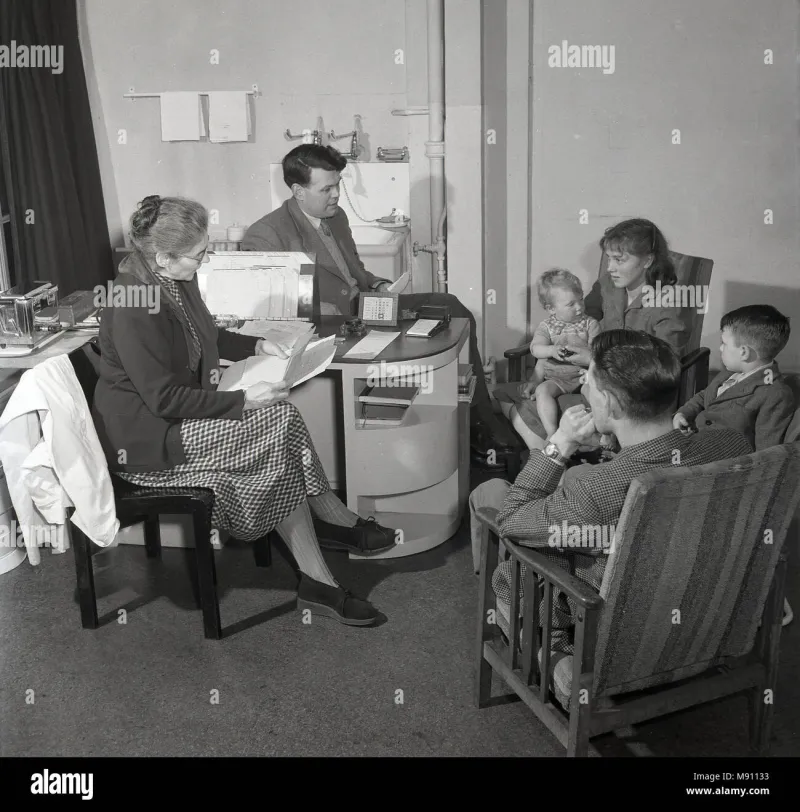
Photo: vintage family doctor house call black and white 1950s, via c8.alamy.com
Somewhere in a box of old family papers, there's probably a name. Maybe it's written on a prescription slip, or scrawled in a birthday card, or spoken in a story your grandmother told. Dr. Henderson. Dr. Marino. Dr. Walsh. One name. One person. The doctor.
Not a practice. Not a patient portal. Not a referral to a specialist who'll refer you to another specialist. Just a man or woman who knew your family, showed up when things got bad, and carried your entire medical history in their head because they'd lived it alongside you.
That world didn't disappear overnight. But it disappeared completely. And most of us are only now starting to feel how much it cost us.
What a House Call Actually Meant
Before the mid-20th century, the house call wasn't a luxury — it was standard practice. If you were sick, the doctor came to you. That wasn't sentimentality. It was logic. You were sick. You couldn't travel. So the care traveled instead.
But beyond the convenience, the house call meant something deeper. It placed the physician inside your life. They saw how you lived — whether the house was warm, whether there was food in the kitchen, whether stress was written on the faces of everyone in the room. That context shaped diagnoses in ways no questionnaire ever could.
By the 1950s and 60s, the American family doctor was a fixture. You might see the same physician for twenty or thirty years. They delivered your children, treated your parents, and knew which health problems ran in your bloodline because they'd watched those problems unfold in real time. Trust wasn't built in a waiting room. It was built over decades.
When Insurance Rewrote the Relationship
The shift didn't happen because doctors stopped caring. It happened because the financial structure of medicine changed underneath them.
As employer-sponsored health insurance became the norm in the postwar era, and as Medicare and Medicaid reshaped the system in the 1960s, medical care increasingly ran through third-party payers. That sounds like an administrative detail. It wasn't. It fundamentally changed who the doctor was accountable to.
When a patient paid their doctor directly — even a modest fee, sometimes in trade — the relationship was between two people. When an insurance company entered the picture, it brought reimbursement codes, documentation requirements, and time constraints that slowly squeezed the human element out of every appointment.
By the 1980s and 90s, the rise of managed care and HMOs turned the clock into the enemy of medicine. Physicians were expected to see more patients in less time. The 15-minute appointment became an industry standard not because doctors thought it was enough time, but because the economics demanded it.
Studies have found that the average American primary care physician now spends less than 18 minutes with each patient — and a significant chunk of that time is spent looking at a screen, entering data into electronic health records that were designed for billing efficiency, not clinical storytelling.
The Rotating Door of Modern Care
Here's something that would have baffled a patient in 1955: today, many Americans don't have a primary care doctor at all. About a third of US adults lack a regular physician, and among those who do, continuity of care is increasingly rare.
Large hospital systems and corporate medical groups — which now employ the majority of American physicians — often operate on rotating schedules. You book an appointment and see whoever is available. The person who treats your sinus infection this month may never see you again. Your records exist in a system, but your story doesn't live in anyone's memory.
This isn't just inconvenient. Research consistently shows that patients with long-term relationships with a single physician have better health outcomes, lower hospitalization rates, and higher rates of preventive care. The relationship itself was medicine.
Diagnostic methods have changed too. Where a seasoned family doctor once relied on pattern recognition built over years of treating the same person — noticing that your color was off, that you'd lost weight since last summer, that you looked the way your father looked before his first cardiac event — modern medicine increasingly relies on tests, scans, and algorithmic screening protocols. Those tools are genuinely powerful. But they work best alongside human judgment, not instead of it.
What the Patient Portal Can't Replace
There's a particular kind of loneliness in modern medical care that nobody talks about much. You're sitting in an exam room, wearing a paper gown, about to discuss something frightening — and the person across from you is a stranger. They're competent. They mean well. But they don't know you.
The patient portal was supposed to solve the communication problem. And in some ways it has — you can message your provider, request prescription refills, and view your lab results at midnight without calling anyone. That's genuinely useful.
But it also means that a lot of medical communication now happens through text boxes and dropdown menus. The phone call from a doctor who wanted to explain something in plain language, who asked how your wife was doing, who remembered that you'd been anxious about this particular result — that's mostly gone.
The Cost We're Still Paying
American healthcare spending is the highest in the developed world by a significant margin. And yet, by nearly every outcome measure — life expectancy, chronic disease rates, maternal mortality — the US trails countries that spend far less.
There are many explanations for that gap. But one that doesn't get enough attention is the erosion of the longitudinal relationship. Preventive care works best when someone is paying attention over time. Chronic disease management works best when a patient trusts their provider enough to be honest. Mental health crises are caught earlier when a doctor notices something is wrong before you say a word.
The old family doctor wasn't perfect. Medicine was less sophisticated, less evidence-based, and far less equipped to handle complex conditions. Nobody is suggesting we go back to a world without MRI machines or laparoscopic surgery.
But somewhere between the house call and the patient portal, we lost something that had real clinical value. The doctor who knew your name wasn't just a nice memory. They were part of how healing happened.
And rebuilding that — in whatever modern form it might take — might be one of the most important things American medicine could do.