The Freedom of Being Unreachable: What We Gave Up When We Got Always-On
Somewhere around 1987, if your boss needed to reach you on a Sunday afternoon, they had two options. They could call your home phone and hope you picked up. Or they could wait until Monday. That was it. There was no third option. And remarkably, the world kept turning.
It sounds almost quaint now — the idea that a working adult could be genuinely, completely unreachable for an entire weekend without anyone treating it as a professional crisis. But that was the rhythm of American life for most of the 20th century. Communication happened on your schedule, within reasonable hours, and the gaps in between were simply understood as normal.
Then came the smartphone. And the gaps closed forever.
When the Answering Machine Was a Boundary, Not a Convenience
Before voicemail, before email, before the little red notification dot that lives rent-free in your brain, Americans managed their communication the way they managed their mail — in batches. You called people when it was a reasonable hour to call. If they weren't home, you tried again later. The answering machine, when it arrived in the 1970s and spread through the '80s, was actually a tool for deferring communication, not accelerating it.
Leaving a message meant accepting that you'd hear back when the other person got around to it. That might be that evening. It might be tomorrow. Nobody expected a response within four minutes. The social contract around communication was built on the assumption that people had lives happening in the space between messages.
Work calls after hours were considered an imposition — something reserved for genuine emergencies. A boss who phoned an employee at 9 p.m. on a weeknight was understood to be crossing a line. That boundary wasn't written into any employment contract. It was just common decency, enforced by the simple fact that showing up uninvited in someone's evening required a pretty good reason.
The Slow Erosion of Off-Hours
The change didn't happen overnight. It crept in gradually, the way most significant shifts do. First came pagers in the 1980s and early '90s, mostly for doctors and people in genuinely time-sensitive professions. Then came early cell phones — expensive, bulky, and still socially understood as tools for emergencies or important business. Then smartphones arrived and rewrote the entire rulebook.
By the early 2010s, the expectation had flipped completely. Being reachable wasn't a courtesy you extended — it was an obligation you owed. Employees began checking work email at 11 p.m. not because anyone explicitly told them to, but because the ambient pressure of constant connectivity made not checking feel like negligence. The phone sitting on the nightstand became a leash with no off switch.
And the data caught up with what people were already feeling. Studies from the American Psychological Association began showing that the mere presence of a smartphone — even face-down on a table — reduced cognitive capacity. The constant low-level awareness that a message might arrive, that someone might need something, turned out to be genuinely exhausting in a way that previous generations simply didn't experience.
What Stress Looked Like Before the Notification
This isn't nostalgia pretending that pre-smartphone life was stress-free. It wasn't. Americans in the 1970s worried about money, health, relationships, and work with the same basic human intensity they do today. But the texture of that stress was different. It came in waves. There were actual breaks — moments when no information could reach you and no response was expected.
A family driving through rural Pennsylvania in 1978 was, for all practical purposes, off the grid. Not because they wanted to be. Just because that's how the world worked. That car trip, that camping weekend, that long Sunday afternoon — these were involuntary disconnection periods that, it turns out, the human nervous system rather needed.
The concept of "work-life balance" barely existed as a phrase before the 1990s, not because work wasn't demanding, but because the physical and technological limits of communication enforced a natural separation that people didn't have to consciously fight for. The balance was structural. It was baked into the infrastructure.
The Relationships That Breathed
There's another dimension to this that doesn't get talked about enough: what constant connectivity did to personal relationships. When reaching someone required effort — a phone call at a reasonable hour, a letter, showing up in person — communication carried a certain weight. You thought about what you wanted to say before you said it. Conversations had stakes.
The slow back-and-forth of a phone call scheduled for Sunday evening, or a letter that took a week to arrive and a week to get a response, created a different kind of intimacy. You had to sit with your thoughts. You had to wait. Waiting, it turns out, is where a lot of emotional processing happens.
Today's communication is faster and more frequent, but many people quietly report feeling more lonely than their parents did. Whether that's correlation or causation is genuinely debated. But it's hard to ignore the irony that a generation with more ways to connect than any in human history also reports some of the highest rates of social isolation on record.
Did We Get the Trade Right?
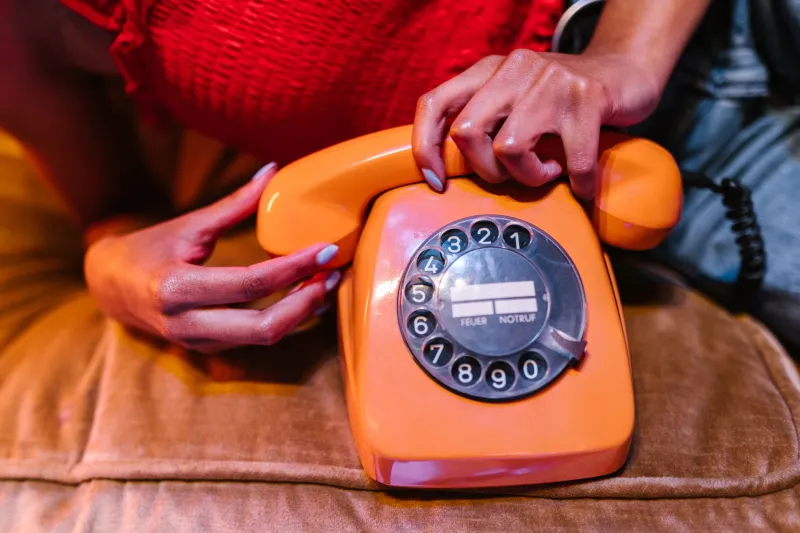
Nobody's seriously arguing that we should go back to rotary phones and postal letters. The genuine benefits of instant communication are real — coordinating families, handling actual emergencies, maintaining relationships across distance. The question isn't whether connectivity is good. It's whether we negotiated the terms well.
Several European countries have begun legislating a "right to disconnect" — formal legal protections that prevent employers from expecting responses outside working hours. France led the way in 2017. Portugal followed. The fact that governments are having to write laws to recreate the boundaries that the old answering machine once enforced naturally says something important about what we lost in the upgrade.
The phone call that could wait until tomorrow wasn't a limitation. It was a gift. And we didn't realize what it was worth until we spent it.