Thirty Volumes of Everything: When American Families Bought Knowledge by the Shelf
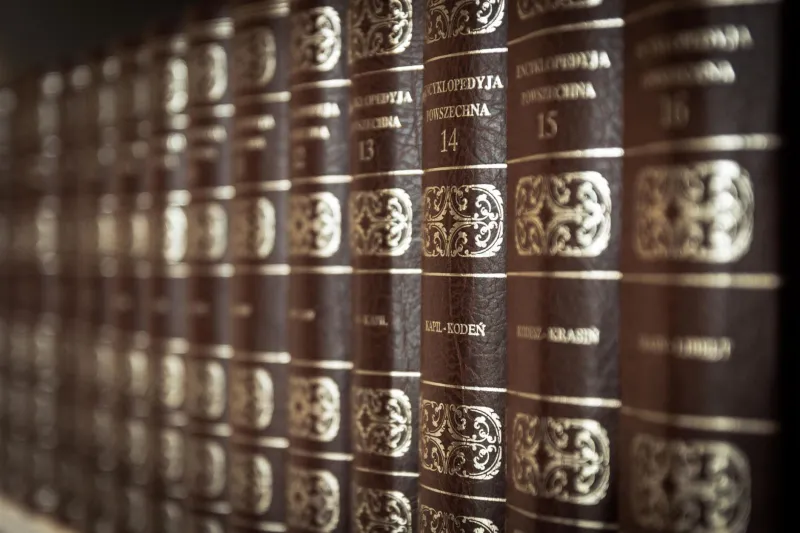
Somewhere in a lot of American homes — tucked into a spare bedroom or stacked in a garage — there's still a set of encyclopedias. The spines are faded. The pages smell like another era. And if you crack one open, you'll find information that was once considered so valuable that a family saved up for months to own it.
It's a strange thing to hold in your hands now. The sum total of human knowledge, organized alphabetically, printed on onion-skin paper, and sold door to door by a man in a good suit who understood exactly what he was offering.
The Salesman at the Door
If you grew up in America between the 1950s and the 1980s, there's a decent chance a World Book or Encyclopaedia Britannica salesman knocked on your door at some point. These weren't casual visits. They were choreographed presentations designed to do one thing: make parents feel that buying a set of encyclopedias was the most responsible thing they could do for their children's future.
The pitch worked because it was true — or at least it felt true in a way that mattered. A complete encyclopedia set in that era cost anywhere from $200 to $1,400 depending on the edition and the extras, which translates to roughly $1,500 to $11,000 in today's dollars. Families often paid on installment plans, making monthly payments the way they might for a appliance or a piece of furniture. This was not an impulse purchase. It was a considered investment, treated with the seriousness of something that would sit in the home for decades.
And it did sit there. For decades. The set didn't get returned when a newer model came out. It aged in place, its information slowly drifting out of date, its presence on the shelf a permanent reminder that this family took learning seriously.
What Those Books Actually Represented
There's something worth understanding about what it meant to own an encyclopedia before the internet existed. Information scarcity was real. If you wanted to know the capital of Madagascar, the population of Brazil, or how photosynthesis worked, you had a limited number of places to look. The library was one. The encyclopedia was another. And the encyclopedia had the considerable advantage of being available at 9 p.m. on a Tuesday when the library was closed and the homework was due.
For many families, especially those without college-educated parents, the encyclopedia represented access to a world that might otherwise feel distant. It was a leveling device. A kid in rural Mississippi with a World Book set had access to the same information as a kid in a wealthy suburb with a library card. That mattered in a way that's hard to fully appreciate now.
The act of looking something up also had its own texture. You pulled the right volume, found the entry, and often kept reading — because the next entry was right there, and the one after that. Serendipitous discovery was built into the format. You went looking for information about volcanoes and ended up reading about Venezuela. Nobody designed that experience. It just happened, because the knowledge was physical and sequential and impossible to filter.
The Day It All Became Free
Encyclopaedia Britannica stopped publishing its print edition in 2012, ending a run that had started in Edinburgh in 1768. By then, the decision was barely news. Wikipedia had already been operating for over a decade, and the idea of paying for encyclopedia access had become almost quaint.
The numbers are almost impossible to process. Wikipedia currently contains over 60 million articles across more than 300 languages. It is updated continuously by tens of thousands of volunteers. It is available for free, instantly, on any device connected to the internet. The entire collected knowledge that a family once saved up to own — and then some, and then vastly more — now lives in everyone's pocket at zero marginal cost.
This should feel like an unambiguous triumph. And in many ways it is. The democratization of information is one of the genuine achievements of the internet era. A curious kid in a low-income household today has access to resources that would have seemed miraculous to a child in 1975.
The Question Nobody Asks
But here's the thing worth sitting with. When knowledge costs nothing and requires no effort to retrieve, does it retain the same weight?
The family that made 24 monthly payments for a set of encyclopedias treated those books differently than we treat a Google search. They were consulted with a certain reverence. Children were directed toward them as a first resort, not a last one. The physical presence of the books in the living room was itself a message: we value this enough to sacrifice for it.
There's no clean answer here. Access to information is better now by almost every measurable standard. But the relationship between a person and knowledge has changed in ways that are harder to quantify. We have more information than any previous generation in human history, instantly available, beautifully organized, and entirely free.
We just don't put it on a shelf anymore. And maybe that's fine. Or maybe something small and important went with it when we stopped treating knowledge like something worth saving up for.