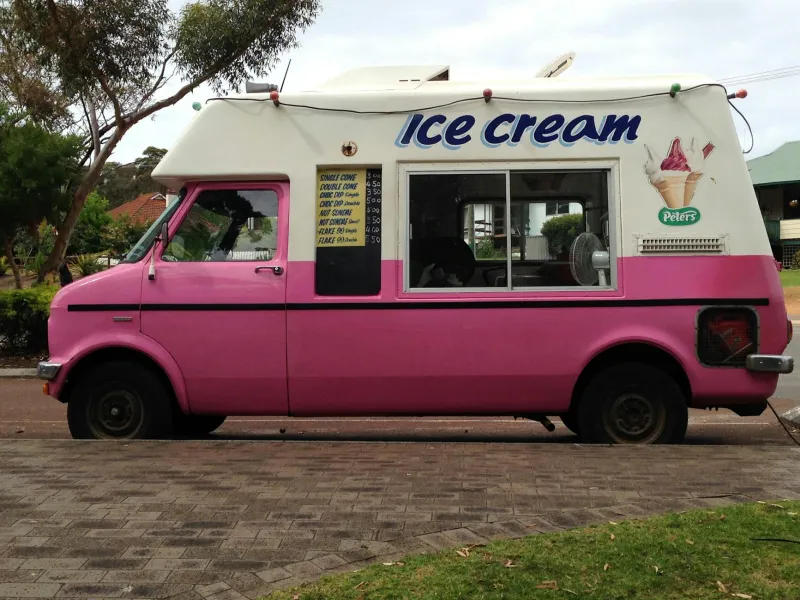
The Sound That Started a Financial Education
Every American over 30 knows the sound: that tinkling melody growing louder as it approached your neighborhood, sending kids scrambling for piggy banks and couch cushions. The ice cream truck wasn't just selling frozen treats — it was operating America's most effective childhood financial education program, one quarter at a time.
Between 1970 and 2000, the ice cream truck served as millions of children's first real encounter with economic decision-making. Kids learned to save, budget, prioritize, and live with the consequences of their choices in ways that today's digital economy simply cannot replicate.
When Money Had Weight and Value Had Meaning
In 1985, a Popsicle cost 50 cents, a premium ice cream sandwich ran 75 cents, and the coveted character-shaped treats with gumball eyes commanded a full dollar. These weren't just prices — they were lessons in financial hierarchy that children absorbed naturally.
Kids understood that money was finite because they could see it, count it, and feel its weight. A five-year-old with three quarters faced a genuine economic choice: the immediate gratification of a cheaper treat, or saving for something better tomorrow. These decisions happened hundreds of times throughout childhood, building financial intuition that no classroom lecture could match.
The physical nature of coins and bills made spending visceral. Children experienced the actual act of handing over money and receiving less in return. They learned that spending meant having less, not just tapping a screen and moving on.
The Art of the Deal at Age Seven
The ice cream truck also taught negotiation and social economics. Kids pooled money for sharing treats, learned to make change, and discovered the concept of bulk purchasing when buying for siblings. Some enterprising children even learned arbitrage — buying extras to sell to friends who'd missed the truck.
Parents often gave children a weekly "ice cream allowance" of $2-3, forcing kids to make their money last or go without. This created natural lessons in budgeting, delayed gratification, and opportunity cost that occurred organically rather than through formal instruction.
Unlike today's allowances that might be transferred digitally or added to a prepaid card, ice cream money was tangible. Children could see their funds depleting, count what remained, and physically experience the relationship between spending and scarcity.
The Emotional Economics of Childhood Desire
The ice cream truck created a perfect laboratory for understanding want versus need. Children experienced genuine desire for treats they couldn't afford, learned to prioritize among competing options, and discovered that financial discipline sometimes meant disappointment.
These weren't traumatic experiences — they were normal parts of childhood that built emotional resilience alongside financial literacy. Kids learned that wanting something and being able to afford it were different concepts, a lesson that many adults today struggle with in our credit-driven economy.
The weekly anticipation of the ice cream truck also taught planning and goal-setting. Children who wanted the premium $1.25 ice cream sandwich learned to save across multiple days, experiencing the satisfaction of achieving a financial goal through patience and discipline.
What Digital Money Cannot Teach
Today's children grow up in an increasingly cashless world. Parents tap cards or phones to make purchases, allowances appear digitally, and spending happens through screens rather than physical exchanges. While convenient, this evolution has eliminated crucial tactile lessons about money.
Modern kids often don't understand that digital transactions represent real money leaving real accounts. The psychological impact of "spending" — the sense of loss that should accompany purchases — gets lost in the frictionless ease of digital payments.
When children do encounter the modern equivalent of the ice cream truck experience — perhaps buying snacks at school or games online — they're often using prepaid cards or parent-controlled accounts that eliminate the scarcity and consequence that made the original experience educational.
The Unintended Consequences of Convenience
Research shows that children who grow up handling physical money develop better financial intuition than those raised in purely digital environments. The tactile experience of counting, saving, and spending coins and bills creates neural pathways that abstract digital transactions cannot replicate.
Financial advisors increasingly report that young adults struggle with basic money management concepts that previous generations absorbed naturally. The ability to visualize money as a finite resource, to feel the weight of financial decisions, and to understand that spending means having less — these intuitive concepts now require explicit teaching.
The Return of Intentional Financial Education
Recognizing what's been lost, some parents are deliberately reintroducing cash-based experiences for their children. They're giving kids physical allowances, encouraging cash purchases, and creating artificial scarcity to replicate the natural financial education that previous generations received.
Financial education programs now teach concepts that children once learned organically through everyday experiences. Schools offer courses on budgeting and saving that attempt to recreate the lessons that corner stores and ice cream trucks once provided automatically.
More Than Just Ice Cream
The ice cream truck represented something larger than childhood treats or even financial education. It was a symbol of independence, decision-making, and the gradual transition from parental control to personal responsibility. Children learned to manage their own small economic sphere, building confidence and competence that extended beyond money management.
In our rush to embrace digital convenience, Americans may have eliminated one of childhood's most effective learning experiences. The ice cream truck didn't just sell frozen treats — it sold financial literacy, emotional regulation, and economic understanding that shaped generations of Americans.
Today's children are growing up with unprecedented access to information and technology, but they're missing the simple, powerful lessons that came from standing on a sidewalk with a handful of quarters, making choices that mattered in their small but important world.
That's a remarkably changed reality that goes far beyond how we pay for ice cream.